Bio
I am a postdoctoral researcher at Leiden University interested in Hybrid Intelligence. My research is interdisciplinary in nature and focuses on the social reasoning abilities — such as Theory of Mind — of computational models like Large Language Models, and how these are acquired, using mechanistic interpretability techniques. This work is carried out together with Max van Duijn, Rineke Verbrugge, and Daniel Balliet.
Being part of the SIM lab - where social intelligence and behaviour is studied in humans, story characters, and machines - my work is always strongly rooted in human cognition and aims to leverage insights from humans to improve LLM understanding. At this intersection of human cognition and AI, I publish at venues including NeurIPS, IJCAI, EMNLP, CogSci, and CoNLL. One of my collaborations addressed the question ‘Is Temperature the Creativity Parameter of Large Language Models’ and is featured on IBM Think and won the Best Student Paper Award at ICCC’24.
I received my MSc with distinction (cum laude) from the Media Technology program at Leiden University, and my BSc in Lifestyle Informatics (AI) at the Vrije Universiteit.
Dissertation
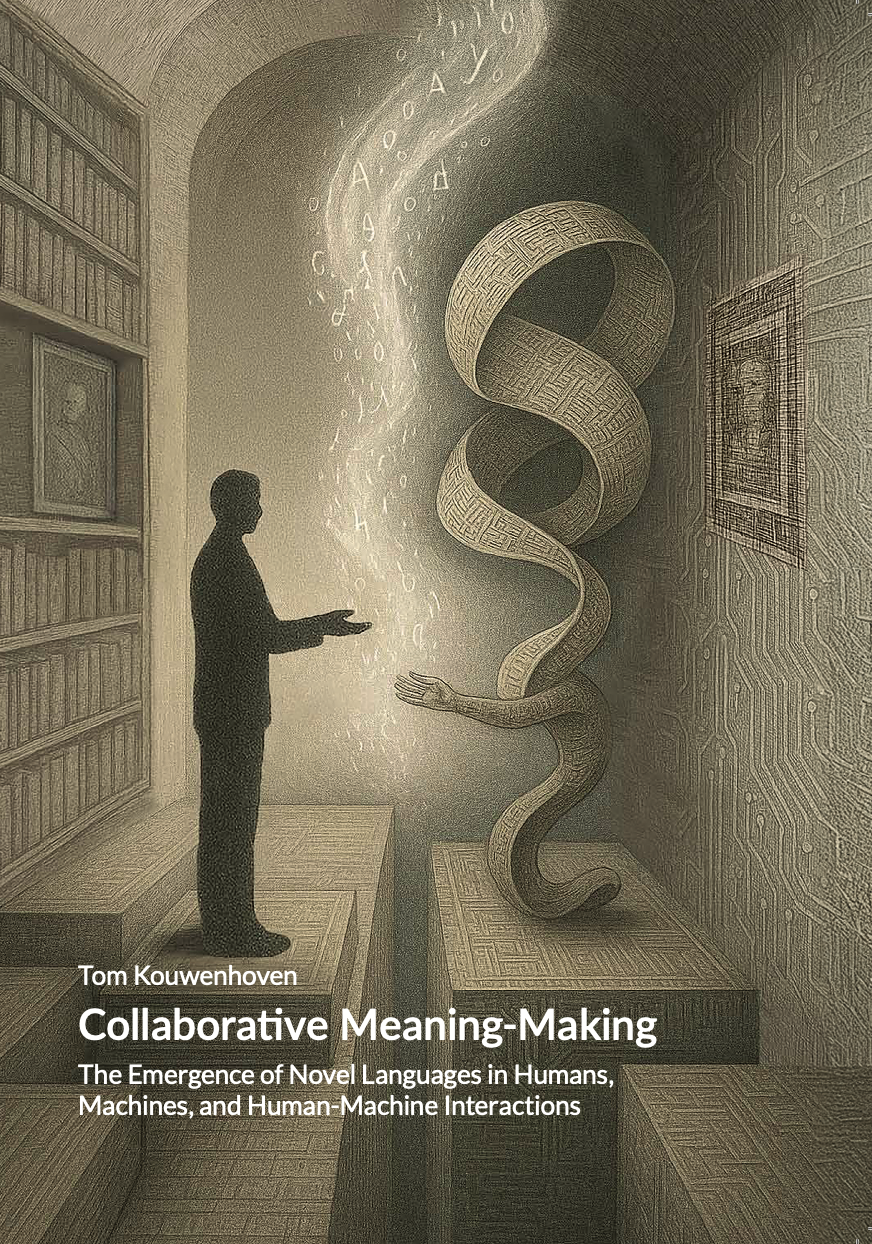
I obtained my PhD in 2025 at the Leiden Institute for Advanced Computer Science (LIACS) as part of the Creative Intelligence Lab. My PhD project, Collaborative Meaning-Making: The Emergence of Novel Languages in Humans, Machines, and Human-Machine Interactions, was supervised by Tessa Verhoef, Roy de Kleijn, and Stephan Raaijmakers. It aimed to improve communication between humans and AI by co-creating shared vocabularies, drawing on Language Evolution and using adaptive machine-learning algorithms and Large Language Models.
Humans share meaning through language. Over time, repeated interactions have shaped languages into forms that match our cognitive preferences, making them structured, expressive, easy to learn, and ultimately, meaningful.
Today, large language models as artificial minds have become proficient new language users too. Though they differ from humans in key respects, they use languages in ways that increasingly mirror the dynamics of human communication.
By studying both humans and artificial models of language in interactive experimental setups, this dissertation aims to uncover how these different kinds of minds create, adapt, and share meaning.
Defence: 30 October 2025, Leiden.
Research interests
My research interests include, but are not limited to the following topics:
- Theory of Mind
- Language Evolution
- Large Language Models
- Human-Machine Interaction
- Artificial Intelligence
- Machine Psychology
Please reach out if you are interested in any of these topics, or if you have an interesting project idea that is suitable for a collaboration, thesis supervision, or internship. I am always open to new collaborations and projects, and I would love to hear from you!